... / Revenue Models and... / Moonshot: Scaling Statewide Founder Support Through a Trust Ladder
Revenue Models and Scaling Strategies for Entrepreneur Support from Make Startups Institute
1. Moonshot: Scaling Statewide Founder Support Through a Trust Ladder
Moonshot is building a way to support entrepreneurs across a statewide geography without relying on the traditional “facility + full local staff” incubator model. Their strategy uses live events as distribution, then moves founders into a standardized Academy pathway where progress creates small, repeatable signals of readiness. That combination is what makes high-volume support possible without sacrificing quality.
Scaling constraint
The traditional incubator price tag breaks rural adoption
When entrepreneur support is delivered as “boots on the ground,” costs often land in a range that most small communities cannot sustain. Scott describes the traditional model as averaging $250,000 to $350,000 per year, once you include facilities, instructors, and staffing. Moonshot’s response is to engineer a lower-cost system that can still deliver continuity and outcomes.
Why this matters to you: if your unit economics require a town to fund a full incubator, you will spend your life rebuilding the same capacity one grant cycle at a time.
So the real questions become:
- How do you deliver high-quality support without replicating full infrastructure in every town?
- How do you maintain quality control and continuity when founders are dispersed?
- How do you show evidence of outcomes strongly enough that participation becomes renewable, not episodic?
Operating model
Pitch Tour as distribution: get founders to show up, then move them into a system
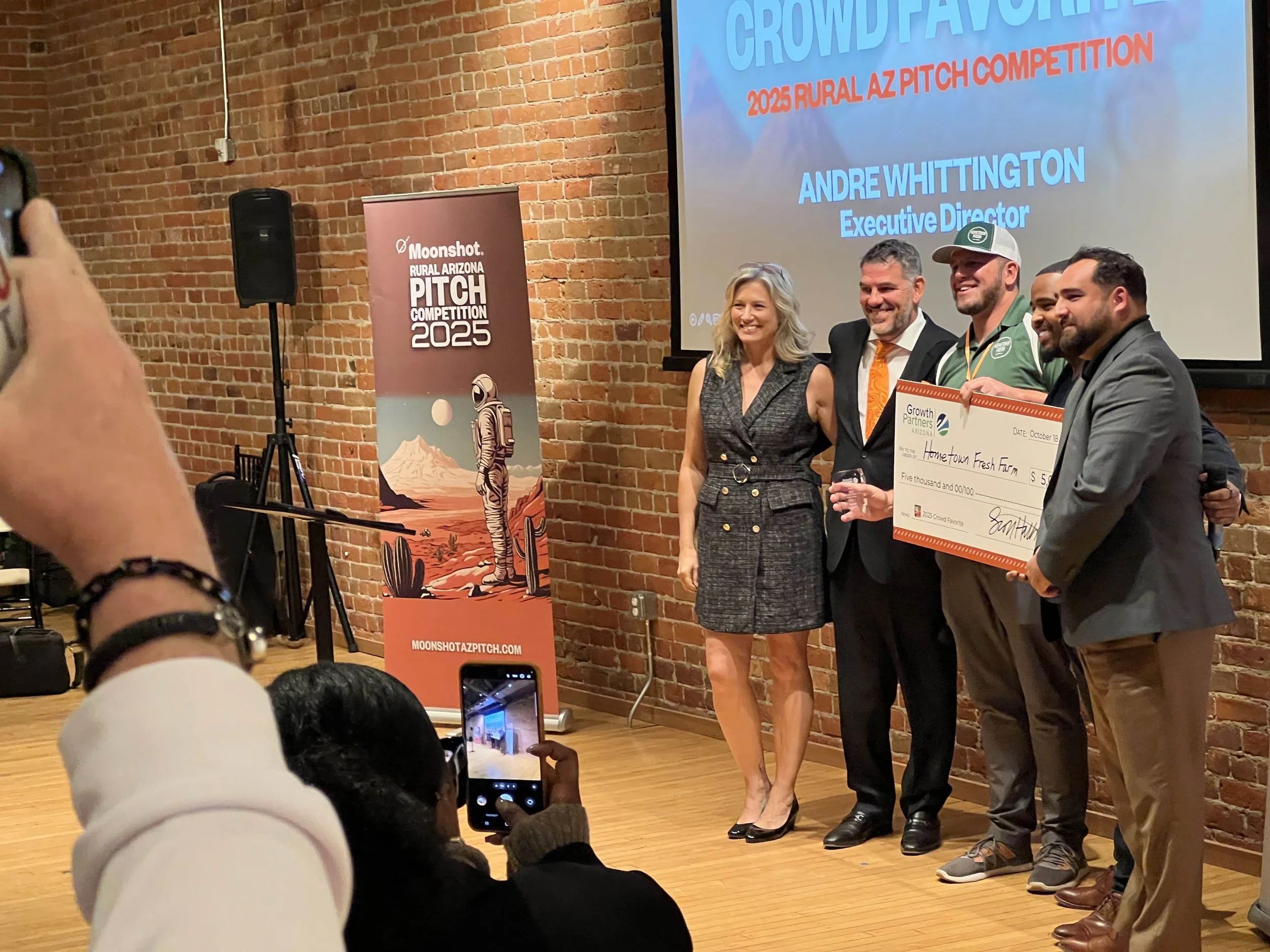
Moonshot’s Pitch Tour is designed to create visibility and momentum in communities. Scott is direct about what the tour is doing: “We’re a marketing vehicle… at the end of the day, I become a game show host,” and the goal is to create enough “stickiness” that founders keep going into curriculum and the work of building.
The critical design move is that the tour is not the end point. Each stop is an on-ramp into Moonshot Academy, where founder progress can be supported consistently across geography.
Building a Trust Ladder
Moonshot uses credentials as micro-signals that move them from measuring "who showed up" to "who's investment ready"
Moonshot Academy uses a two-tier credential pathway to turn learning into visible progress: Market Ready and Launch Ready. These credentials are positioned as signals that are meaningful to capital providers, not just internal milestones.
In practice (as implemented through the Pitch Tour workflow), founders move through a ladder where each rung creates a small signal that unlocks deeper resources, more time from mentors, and eventually higher-stakes opportunities like Pitch Finals.
The ladder in one view
| Step | What the founder does | What it signals | What it unlocks |
|---|---|---|---|
| Tour stop onboarding | Joins the Academy pathway | “Engaged and active” | Timed window to complete Market Ready |
| Market Ready | Completes Market Ready using on-demand AI mentoring | “Ready to execute fundamentals” | Eligibility to move toward Launch Ready |
| Launch Ready track | Builds the financial and operating discipline | “Operating maturity is forming” | 1-on-1 mentor time and tools |
| Launch Ready + Data Room | Completes Launch Ready and sets up a Data Room | “Due diligence-ready proof” | Qualification signals for Pitch Finals |
What Market Ready and Launch Ready actually mean
Moonshot’s credentials are defined as different levels of business maturity.
- Market Ready entrepreneurs have validated go-to-market strategy, identified customer pain points, and locked in a revenue model before formalizing the business. They are past the idea stage and ready to execute.
- Launch Ready entrepreneurs go further: they build financial projections, understand unit economics, and develop the operational infrastructure to deploy capital effectively. This is also the credential that unlocks data room functionality.
This separation matters because it prevents you from treating every founder like they need the same thing. It also prevents mentors from spending scarce time on founders who have not yet done baseline work.
The Data Room gate: turning “trust” into structured proof
Moonshot Academy changes the investor-founder relationship by ensuring founders only gain access to a secure data room after completing Launch Ready requirements. That gate creates a baseline of preparedness before documents are shared, and it gives reviewers confidence they are seeing disciplined work rather than aspirational pitching.
The goal is reducing friction in diligence:
- materials are organized (financial models, validation, go-to-market, ops plans)
- readiness indicators provide consistent signals
- founders control what they share and when
If you are building entrepreneur support, this is a useful pattern: instead of trying to “convince” capital partners that your cohort is strong, you design gates that produce proof naturally.
Scaling human mentorship without burning out your team
Moonshot’s ladder design protects mentor time by sequencing it.
- Early-stage founders move fast with structured guidance and on-demand support.
- One-on-one mentorship becomes most intense once founders have demonstrated follow-through and are working toward Launch Ready.
This is what makes high-volume statewide support possible: the system handles repeatable work consistently, and humans focus on the founders who are actually progressing.
One additional scaling choice is runway: every Launch Ready graduate receives two years of access to the platform, supporting the transition from idea to early revenue as operating momentum forms.
Revenue model implications: “seats into a system,” not a building or a grant cycle
Moonshot’s scaling logic is tied to a funding logic. When the traditional approach costs $250,000 to $350,000 per year, most towns are priced out. So Moonshot builds toward a different number, described as being close to a $25,000 model that assists smaller communities.
The strategy then becomes: prove outcomes, then sell participation in small, practical units that communities can renew. Scott describes the move as returning to towns with evidence and asking, “How about you pay for five seats,” with a menu that can scale up.
This is also where infrastructure matters: Scott links partnering with Make Startups and CofounderOS to being able to correlate founder work to economic development outcomes and make an ROI case that is not only “feel good,” but measurable.
Pro Tip
When outcomes become measurable, participation becomes financeable. That is how you get out of episodic funding.
What to borrow: a practical checklist for your own organization
If you want to apply this model in your market, start here:
- Define a ladder with 2 to 4 rungs. Each rung should end in a deliverable, not just attendance.
- Name the signals. Make them simple and legible (Market Ready, Launch Ready, Data Room Enabled).
- Gate scarce resources (1-on-1 mentors, demo days, pitch finals) behind signals so your team is not constantly triaging.
- Build a proof packet. Decide what artifacts demonstrate readiness and organize them in one place.
- Productize participation. If you serve multiple towns, explore “seats” or another repeatable unit instead of facility funding.
- Measure outcomes early. The goal is not dashboards for their own sake, but credibility that makes renewal easier.
FAQ
How is this different from a normal pitch competition?
A normal pitch competition often rewards performance in a moment. Moonshot’s ladder ties high-stakes opportunities to readiness steps completed over time, so founders earn visibility by building evidence, not just a deck.
Why use credentials instead of just “required workshops”?
A credential is a signal that can travel across partners. It is easier for lenders, mentors, and investors to interpret than “they attended a workshop.”
Why gate the data room?
Because it converts confidence into proof. Founders only unlock the data room after Launch Ready, creating a baseline of preparedness that reduces diligence friction.
What’s the point of the “two years of access” window?
It matches founder reality. Momentum builds unevenly, and continuity matters more than cohort calendars.
Final Takeaway
Moonshot’s scale is not only about reaching more towns. It’s about building a ladder where progress is visible, consistent, and evidence-backed, so founder support can be delivered at high volume without becoming chaotic or purely relationship-dependent.
Moonshot is building a way to support entrepreneurs across a statewide geography without relying on the traditional “facility + full local staff” incubator model. Their strategy uses live events as distribution, then moves founders into a standardized Academy pathway where progress creates small, repeatable signals of readiness. That combination is what makes high-volume support possible without sacrificing quality.
| Category | Revenue Models and Scaling Strategies for Entrepreneur Support |
| Curriculum | all |
| Created | 2026/02/22 |
| Last Updated | 2026/02/22 |
| Content Details | |
| IMI Provider | CofounderOS |
| Published | Make Startups Institute |

|
|
- Moonshot: Scaling Statewide Founder Support Through a...
Make Startups Institute is using CofounderOS to help founders design, launch, and scale their businesses.
Financial aid and scholarship packages are available for most programs.